Shrimad Bhagvad Gita
Norway

Shrimad Bhagvad Gita

Sample photo

Causes Of Rebirth

"Om namo bhagavate vasudevayah"
 
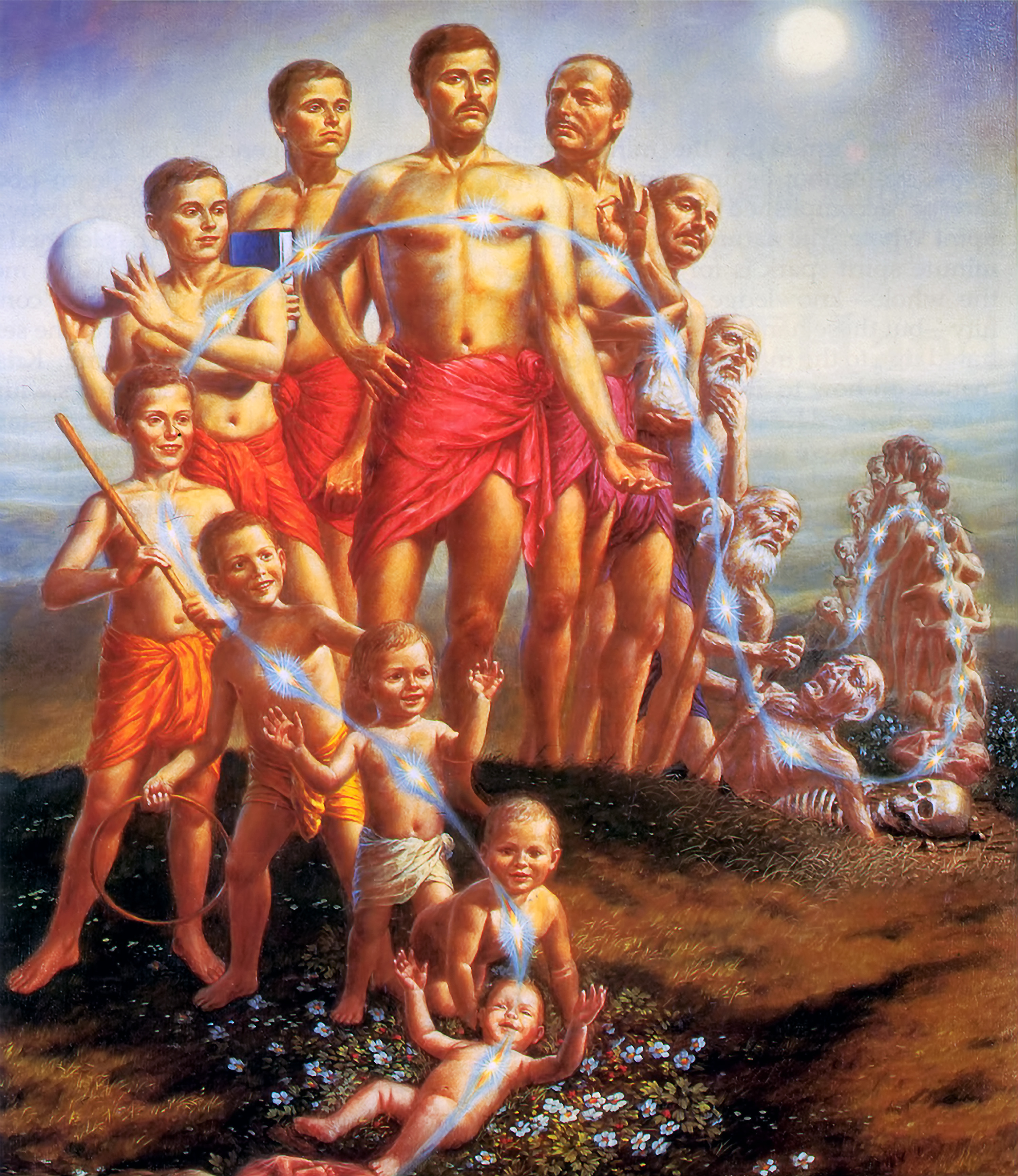
The present life of a living being is just one among many. A soul passes through countless bodies, taking birth again and again. As discussed in an earlier post, every soul is a part of the Supreme Soul, the Supreme Purusha—Bhagavan Shri Krishna.

This brings up a natural question:
If the Purusha (Ātma), which originates from the Supreme Purusha and is destined to reunite with Him, then why does it get caught in the cycle of birth and death?
The answer lies in attachment—to the body and the material world. The soul, deluded by material pleasures, begins to identify with the body and forgets its true spiritual nature. It starts believing that this material world is its home. As a result, it becomes bound to the cycle of birth, death, and rebirth.

This

... Read More

Today's Shloka

Ch 13 : Sh 16

बहिरन्तश्च भूतानामचरं चरमेव च ।
सूक्ष्मत्वात्तदविज्ञयं दूरस्थं चान्तिके च तत् ॥

It is inside as well as outside, in the moveable and the immoveable creatures. Being subtle,It is not knowable. It is far away, and yet so very near.

Purport

The last Shloka describes the characteristics of Brahman, explaining that it illuminates the functions of all the senses in every living being and receives the inputs of everything experienced through the senses. This implies that everything done and experienced by living beings is known to Brahman.

This Shloka describes three other characteristics of the great Brahman.

These characteristics are:

1. Existence of Brahman throughout the universe

Brahman exists both inside and outside every living and non-living being, including everything that is movable and immovable. This characteristic explains how Brahman is omnipresent. It also supports the characteristics described in the earlier Shloka, which explains that Brahman supports the senses and knows their experiences.

2. Subtlety

Brahman is described as “सूक्ष्मत्वात्तदविज्ञयं”, meaning that it is so subtle that it cannot be comprehended by the mind and sense organs.

3. Far yet near

Brahman is described as “दूरस्थं चान्तिके”, meaning that it is both far and near. At first, this may appear contradictory. Something can ordinarily be either far away or near, but Brahman is described as both far and near.

All these characteristics, together with those described in the earlier Shlokas, lead to an important conclusion: Brahman can be understood as a field that pervades everything, yet has its ultimate source in a reality beyond the reach of ordinary perception.

If we also consider the nature of Brahman described in Chapter 14, Shloka 3, which explains Brahman's relationship with Bhagavan Shri Krishna, we can further infer that Brahman is the field of life whose ultimate source is none other than Bhagavan Shri Krishna.

Brahman pervades the entire universe. It can be compared to the arms of Bhagavan Shri Krishna, through which Bhagavan Shri Krishna perceives everything happening in the universe. This analogy helps explain how Shri Krishna is omnipotent and how Brahman is sometimes referred to as God. According to this understanding, Bhagavan Shri Krishna and Brahman are inseparable and belong to one ultimate reality.

This concept can also help explain other complex ideas, such as the existence of the soul and Moksha. It is said that, upon attaining Moksha, the soul attains Brahman. Elsewhere, Moksha is described as attaining God, Bhagavan Shri Krishna. These two descriptions can be understood as expressing the same ultimate attainment within the philosophical framework explained above.

“Shri Hari Om Tat Sat”